Compressed air touches more of your production line than almost any other utility. In a food plant it blows across open product; on a pharmaceutical filling line it drives valves beside a sterile environment; in electronics it feeds instruments that tolerate only micron-level contamination. In all of these places, "oil-free or oil-lubricated?" is not a budget question — it is a product-safety question.
This guide explains how an oil-free rotary screw air compressor works, what ISO 8573-1 Class 0 actually certifies, and how to choose between oil-free and oil-injected technology without over-specifying (and over-paying).
A rotary screw compressor compresses air between two intermeshing helical rotors. In an oil-injected (oil-lubricated) design, lubricant is sprayed directly into the compression chamber, where it seals rotor clearances, absorbs compression heat and lubricates the moving parts. The oil is then separated from the air downstream — but separation is never total, so a residual film of oil aerosol and vapour stays in the airstream and must be scrubbed out with coalescing and carbon filters.
An oil-free compressor removes oil from the compression chamber entirely. The rotors are held in precise alignment by timing gears so they never touch, and no lubricant enters the air path. Oil may still lubricate a gearbox or bearings, but it is physically isolated from the compressed air. That isolation is the whole point: it removes compressor oil as a contamination source rather than relying on a filter that can saturate, break through or be forgotten during maintenance.
There are two ways to build an oil-free screw compressor, and the difference matters when you specify:
Both can reach ISO 8573-1 Class 0 for oil. For plants that want the simplest possible contamination-control story, dry screw remains the most widely specified.
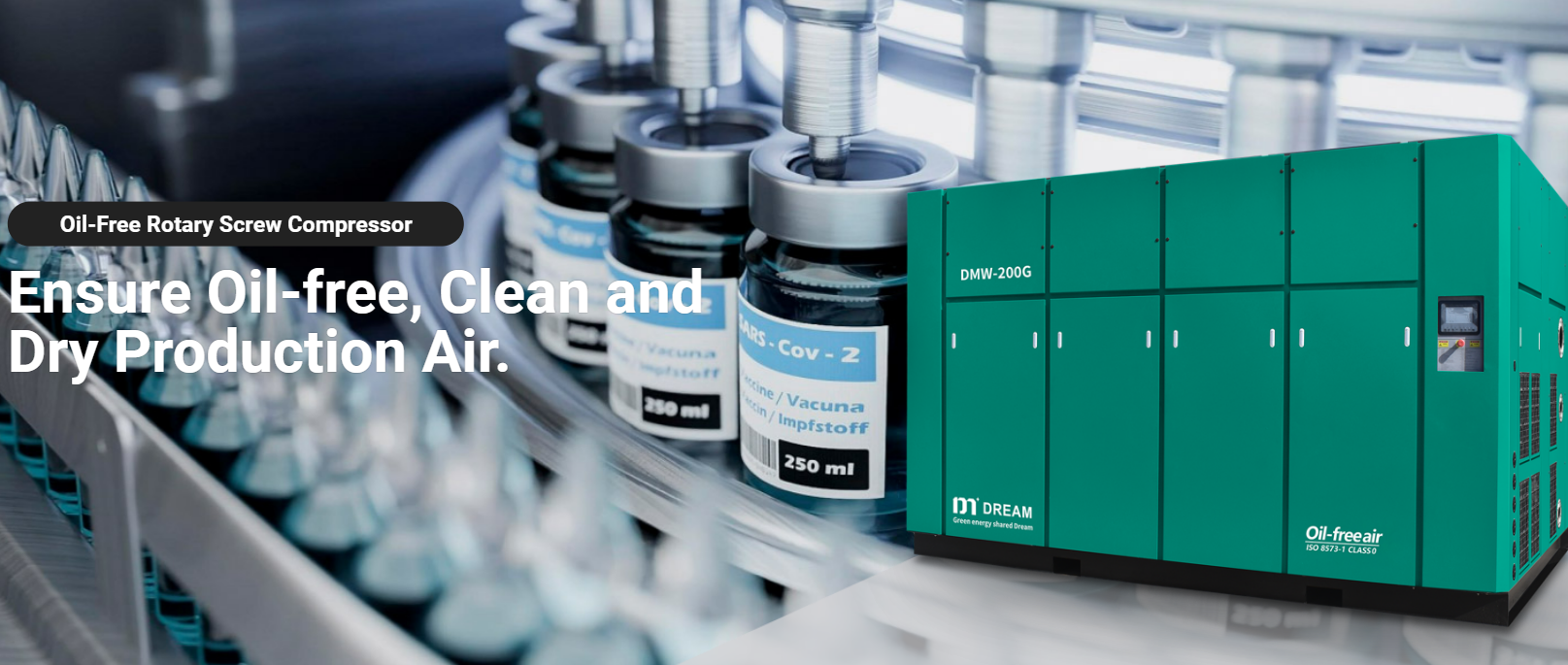
ISO 8573-1 is the international standard that classifies compressed-air purity across three separate contaminants: particles, water and oil. "Class 0" is the most stringent oil class — but it is not a fixed number. The limit is defined by the equipment supplier and the user, and must be stricter than Class 1 (≤ 0.01 mg/m³ total oil).
| Class | Max total oil content | Typical use |
| Class 0 | Defined by supplier/user, stricter than Class 1 | Direct product contact: food, pharma, medical, semiconductor |
| Class 1 | ≤ 0.01 mg/m³ | High-purity instrument air |
| Class 2 | ≤ 0.1 mg/m³ | Precision manufacturing |
| Class 3–4 | ≤ 1–5 mg/m³ | General pneumatic tools, bulk conveying |
The practical takeaway: an oil-free compressor prevents compressor-generated oil from entering the air, but atmospheric moisture and particles still exist. A complete system pairs the compressor with a dryer and filtration to hit the class your process actually needs.
| Factor | Oil-Injected | Oil-Free (Dry Screw) |
| Air purity | Trace oil; needs filtration | No compressor oil in the air path |
| Food / pharma / med | High contamination risk | Compliance-ready (Class 0 achievable) |
| Maintenance | Oil, filter and separator changes + oil disposal | No oil changes on the air side |
| Upfront cost | Lower | Higher |
| Best for | General workshop, pneumatic tools | Product-contact and contamination-sensitive processes |
Specify oil-free whenever compressed air comes into direct or indirect contact with a product, its packaging, or a product-contact surface. That usually means:
If a batch rejection, a failed audit or a product recall is the cost of contamination, oil-free is not a luxury — it is the cheaper option. Filter failure on an oil-injected machine is a risk you can eliminate at the source instead of managing downstream.
Once you have decided oil-free is required, match the machine to your real duty:
Choose oil-lubricated only when the air never touches a sensitive product and correctly maintained filtration is acceptable. Choose oil-free when product safety, hygiene compliance or yield is at stake — and choose a dry screw, VSD-driven, IE5 oil-free compressor when you also want the lowest long-term energy cost.
You can explore the full range, from 22 kW to 560 kW, on the DREAM dry oil-free rotary screw air compressor page, or tell us your pressure and flow requirement and we will size the right unit for your line.
Is an oil-free compressor the same as an oil-less compressor?
Yes — "oil-less" and "oil-free" both describe a compressor that does not inject lubricant into the compression chamber. "Oil-free" is the more common industry term for screw and scroll designs.
Can I use an oil-lubricated compressor with filters for food or pharma?
It is strongly discouraged. Filters can saturate or fail, letting oil through. True oil-free technology provides an inherent barrier rather than a replaceable one.
Does an oil-free compressor still need a dryer and filters?
Yes. Oil-free removes compressor oil, but atmospheric moisture and particles remain. Add a refrigerated or desiccant dryer and filters to reach your target ISO 8573-1 class.
How do I size an oil-free screw compressor?
Add the air consumption of every connected device, then add 15–25% for leaks and future expansion. Confirm the result sits inside your pressure and flow range before ordering.
What maintenance does a dry oil-free screw compressor need?
No oil changes on the air side. Servicing focuses on air filters, timing-gear/bearing lubrication and rotor-coating inspection at manufacturer-specified intervals.