Walk through any air-jet weaving mill and you'll hear it before you see it: the rhythmic hiss of compressed air firing through the nozzles, thousands of times per minute, driving weft yarn across the warp. It's the sound of production. It's also the sound of your second-largest electricity bill.
Compressed air is the lifeblood of modern textile manufacturing — but it's also the most overlooked line item in most plants' operating budgets. In spinning, weaving, dyeing, and finishing, compressed air drives pneumatic cylinders, controls yarn tension, cleans machinery, and powers the air-jet looms that have replaced shuttle looms across the industry.
According to the U.S. Department of Energy's Compressed Air Challenge program, compressed air systems typically account for 10–15% of a plant's total electricity consumption — but in textile plants, where air-jet looms, pneumatic cylinders, and yarn handling systems run continuously, that figure often climbs higher. A medium-sized weaving mill may carry 500 kW to over 1,500 kW of connected compressor load. A 10–15% efficiency gain on that load is not a rounding error. It is a line item your competitors will use against you.
Here's the problem most plant managers inherit: someone, years ago, bought standard 7–8 bar compressors for the whole plant. They work. But they're forcing the compressor to fight against its own physics. And in a textile plant, that's an expensive habit.
In air-jet weaving, the pressure required at the loom manifold typically falls in the 5–7 bar range, depending on loom type and speed. But many textile processes run even lower: yarn aspirators, pneumatic conveying, and general plant air often operate at 3–4 bar. Older mills using 7–8 bar compressors then drop pressure through regulators — a practice that doesn't just waste energy, it creates the conditions for oil carryover and unstable pressure bands.
The thermodynamics are straightforward, even if the sales pitch usually isn't. A screw compressor optimized for 3–5 bar discharge can deliver 25–40% more air volume from the same motor kW compared to a standard 7–8 bar machine. That's not a marginal gain. That's the difference between running three compressors and running two.
The reason is compression ratio. A standard 8 bar compressor compresses ambient air roughly 9:1. A 3 bar compressor compresses it roughly 4:1. Less compression per unit of air means less heat, less mechanical stress, and more of your motor's power converted into useful airflow rather than waste heat.
For a textile plant running 4,000–6,000 CFM of low-pressure air — which is typical for a medium-sized air-jet weaving operation — the energy delta between a properly specified low-pressure machine and a standard 8 bar unit can exceed 100 kW of continuous load. At industrial rates, that's a six-figure annual difference.
The DreamCompressor low-pressure oil-injected PM VSD screw air compressor platform is built specifically for this operating window. Power ranges from 22 kW to 250 kW, with working pressures of 3–5 bar and air delivery from 1.8 to 65 m³/min. But the specifications only tell part of the story. The engineering decisions behind them are what make the difference.
Airend geometry. The compression element is not a standard 8 bar airend dialed down. It uses a rotor profile and compression ratio optimized for low-pressure operation, with enlarged air delivery per revolution. The lower compression ratio also means lower discharge temperatures, which extends bearing and seal life.
Permanent magnet motor. The PM motor maintains high efficiency across a wider speed range than conventional induction motors — critical for textile plants where air demand fluctuates with production schedule and loom speed changes. At partial load, the efficiency advantage widens.
Variable speed drive. This is where the real-world savings compound. Textile plants rarely operate at steady state. Looms start and stop in batches. Shift changes drop demand by 30–40% for 20–30 minutes. Weekends run at a fraction of weekday load. A VSD compressor matches output to actual demand rather than cycling between full load and unload — a mode that wastes significant energy in every unload cycle.
According to the U.S. DOE's Compressed Air Challenge, variable speed control on screw compressors typically reduces energy consumption by 25–35% in applications where load varies by more than 30%. Textile plants are the textbook case: shift changes drop demand by 30–40% for 20–30 minutes, weekends run at a fraction of weekday load, and loom speed adjustments change air consumption throughout the day. In this operating environment, a fixed-speed compressor cycles between full load and unload — a mode that wastes significant energy every time it unloads. A VSD machine matches output to actual demand instead.
There's a common misconception in the textile industry that "oil-free" is always required. It's not — but that doesn't mean oil content can be ignored.
The standard requirement for air-jet weaving is a maximum oil content of 0.1 mg/m³, which corresponds to ISO 8573-1 Class 2 for oil. Textile weaving air quality is typically specified as ISO 8573-1 Class 2.4.2, meaning oil at ≤0.1 mg/m³, pressure dew point at +3°C (achievable via a refrigerated dryer), and particulate filtration adequate for the application.
Oil contamination in textile processes — even at low concentrations — causes specific, measurable problems: oil particles adhere to loom nozzles, reducing jet force and distorting the weft insertion trajectory. They contaminate fabric surfaces, increasing defect rates. And in the plant environment, atomized oil spreads through the workshop air, affecting employee health and requiring additional ventilation costs.
A properly specified oil-injected low-pressure compressor with multi-stage filtration can meet ISO 8573-1 Class 2 for oil content without the cost premium of oil-free technology. The key is the filtration package, not the compressor type. For textile applications where air does not directly contact the finished fabric in critical processes, Class 2 oil content is the appropriate specification — not Class 0.
That said, if your plant runs both air-jet weaving and processes where direct fabric contact occurs (certain finishing operations, for example), you may need to evaluate whether a zoned air system — with different quality levels for different areas — makes more sense than treating the entire plant to the highest standard.
Here's something that doesn't show up in most procurement documents but matters enormously in practice: pressure stability.
Air-jet looms are sensitive to pressure fluctuation. When supply pressure drops below the loom's reference pressure, weft insertion fails — the yarn doesn't reach the far side of the shed. The loom stops. Production halts. On a high-speed loom running 500–600 rpm, a single pressure dip can cascade into multiple loom stoppages before the system recovers.
The common requirement is a pressure fluctuation of less than 0.01 MPa (0.1 bar) at the loom manifold. Meeting that with a standard compressor that cycles between load and unload is difficult. The pressure band during unloading — when the compressor isn't producing air but the system is still consuming it — creates the exact instability that causes weft insertion faults.
A VSD compressor with a properly sized air receiver and well-designed piping minimizes this pressure band. The compressor runs continuously at variable speed, tracking demand, rather than switching on and off. The result is a tighter pressure band, fewer loom stoppages, and more consistent fabric quality.
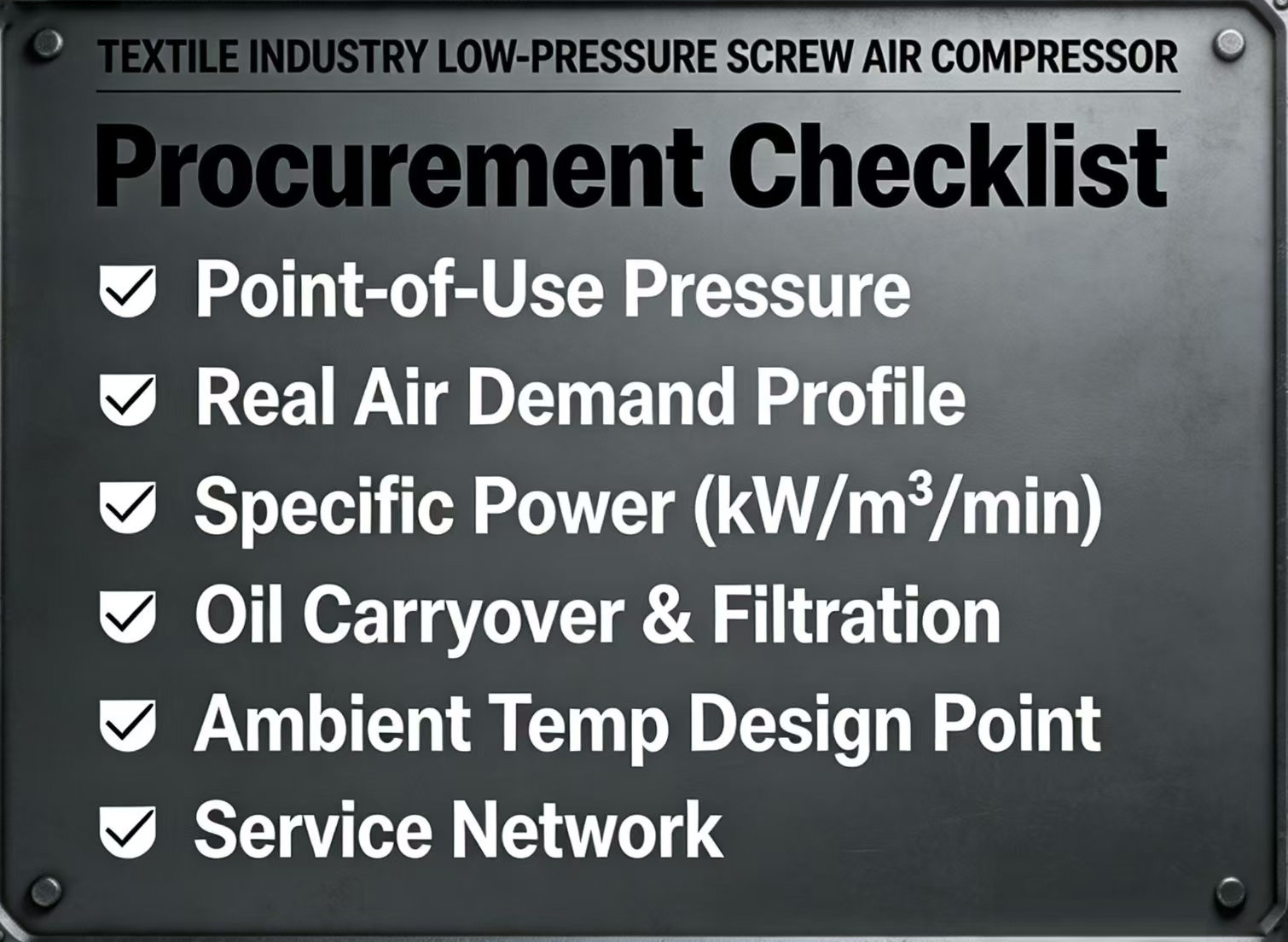
1. What is the actual pressure required at the point of use, not at the compressor outlet?
Most textile plants know their "system pressure" — but that's often the compressor discharge pressure, not what the looms actually need. Measure pressure at the loom manifold during peak production. If it's 5.5 bar, you don't need a 7.5 bar compressor. You need a 6 bar compressor with properly sized piping and minimal pressure drop.
2. What is the real air demand profile, hour by hour?
Compressed air demand in textile plants varies significantly by shift, by product mix, and by loom speed. A VSD compressor's value depends on how much the load varies. Ask for a week-long data log of air consumption before sizing. A compressor sized for peak demand without VSD will waste energy during off-peak hours. A VSD machine sized for average demand with a small receiver buffer will run more efficiently across the full range.
3. What is the specific power (kW per m³/min) at your operating pressure — not at rated pressure?
This is the single most important efficiency metric, and it's almost never included in standard quotations. A 22 kW compressor at 3 bar should deliver roughly 4.5–5.5 m³/min. A 22 kW compressor at 8 bar delivers about 3.5–4 m³/min. If the supplier quotes you the 8 bar figure for a 3 bar application, they're either quoting the wrong machine or hiding the efficiency gap.
4. What is the oil carryover specification, and what filtration is included?
The compressor's rated oil carryover (typically 2–3 ppm for oil-injected screw compressors) is not the same as the air quality delivered to your looms. You need coalescing filters and a refrigerated dryer in the package to achieve ISO 8573-1 Class 2.4.2. Ask for the filter specification and replacement interval — this is a recurring cost that should be in your TCO calculation.
5. What is the ambient temperature design point for the compressor room?
Textile plants, especially in tropical and subtropical regions, often have compressor rooms that reach 40°C or higher. A compressor rated for 45°C ambient with no margin will run hot, trip on high temperature, and degrade motor insulation faster. Ask for the rated ambient temperature and the derating curve above it.
6. What is the service network in your region?
A low-pressure PM VSD compressor is not a commodity machine. It requires technicians trained on the specific airend, VSD drive, and control system. Get the name and location of the actual service provider, the average response time for a breakdown call, and the lead time for critical spare parts (airend bearings, VSD module, controller). If the nearest trained technician is 1,500 km away, factor that into your risk assessment.
Textile manufacturing operates on thin margins. A compressed air system decision that adds $20,000 per year in unnecessary energy cost is a competitive disadvantage that compounds annually.
Here's how to frame the comparison:
| Factor | Standard 7–8 bar Compressor | Low-Pressure PM VSD (3–5 bar) |
|---|---|---|
| Motor power for same air output | Baseline | 20–40% less |
| Annual energy cost (4,000 CFM, 8,000 hrs) | Baseline | 25–35% lower |
| Pressure stability at loom | Wider band, more stoppages | Tighter band, fewer stoppages |
| Oil carryover to looms | Higher if filtration undersized | Controlled with proper filtration |
| VSD turndown for variable load | Limited (if fixed-speed) | Full range (25–100%) |
| Maintenance complexity | Standard | Similar, but requires trained technicians |
Energy consumption represents over 80% of a compressor's total lifecycle cost. In a textile plant running 8,000 hours per year, the energy difference between a correctly specified low-pressure VSD machine and a standard fixed-speed 8 bar unit will typically exceed the purchase price difference within 18–24 months.
The textile industry's shift toward air-jet weaving, higher loom speeds, and tighter quality standards has made compressed air a strategic cost center, not a utility afterthought. The plants that treat it that way — by specifying the right pressure, the right motor technology, and the right control strategy — are the ones that will maintain margin as energy costs rise and competition intensifies.
Low-pressure PM VSD screw compressors are not a niche product. They are the correct specification for the majority of textile compressed air applications. The question is whether your procurement process is designed to capture that value — or whether you're still buying 8 bar machines and regulating pressure down, paying for compression you never needed.
Know your real pressure requirement. Know your real demand profile. Know your real energy cost per m³ of air. Those three numbers will tell you whether a low-pressure VSD machine is an upgrade or a necessity.