If you've been shopping for oil-free compressed air lately, you've probably noticed something: the conversation usually starts with dry screw technology and ends with sticker shock. Dry screw compressors are the gold standard for oil-free air — they've been around for decades, and every major brand has a mature platform. But the premium is real: 30–50% more than oil-lubricated equivalents, plus higher energy consumption and maintenance costs that tend to surprise first-time buyers.
What gets less attention is the technology that's been quietly gaining ground in food, pharma, and electronics plants across Asia and Europe: water-lubricated oil-free screw compressors. Instead of relying entirely on mechanical precision to keep rotors from touching, these machines inject purified water into the compression chamber to seal, cool, and lubricate. The result is 100% oil-free air at ISO 8573-1 Class 0 — but with a fundamentally different cost and maintenance profile.
Here's what I've learned specifying both technologies, and what you should ask before choosing between them.
The concept is straightforward. A water-lubricated screw compressor uses a single-stage airend where water is injected directly into the compression chamber. The water forms a film between the rotors and the casing, providing sealing and lubrication while absorbing the heat of compression. Because water has roughly twice the cooling capacity of oil, discharge temperatures stay low — typically below 50°C, compared to 200°C+ in dry screw airends.
Lower operating temperatures mean less thermal stress on components, which translates to longer service life and more stable performance over time. It also means the machine operates closer to isothermal compression — the thermodynamic ideal — which is why water-lubricated units often show better energy efficiency than dry screw machines of comparable output.
The water itself is managed through a closed-loop system with filtration and separation. After compression, the water is separated from the air, cooled, filtered, and recirculated. The condensate discharged is clean water — no oil sludge, no special disposal requirements. The Dream DMWV-G series, for example, uses 304 stainless steel piping throughout to prevent corrosion, with multi-stage water separation and filtration built into the package.
The Dream DMWV-G series covers a different range than the dry screw platform. Here's what matters:
| Parameter | Range | What It Means for You |
|---|---|---|
| Power | 22–132 kW (30–180 HP) | Mid-range industrial; one or two units cover most plant-wide demands |
| Working Pressure | 7–10 bar (101–145 psig) | Standard industrial range |
| Air Delivery | 1.8–25 m³/min (64–883 CFM) | Wide turndown; VSD option extends modulation range |
| Certification | ISO 8573-1 Class 0, CE, ISO 9000, SGS | The Class 0 certificate covers the complete package |
| Motor | IE5 Permanent Magnet Synchronous | Significant energy savings vs. IE3 induction motors |
| Cooling | Air or water-cooled | Water-cooled for high ambient or enclosed rooms |
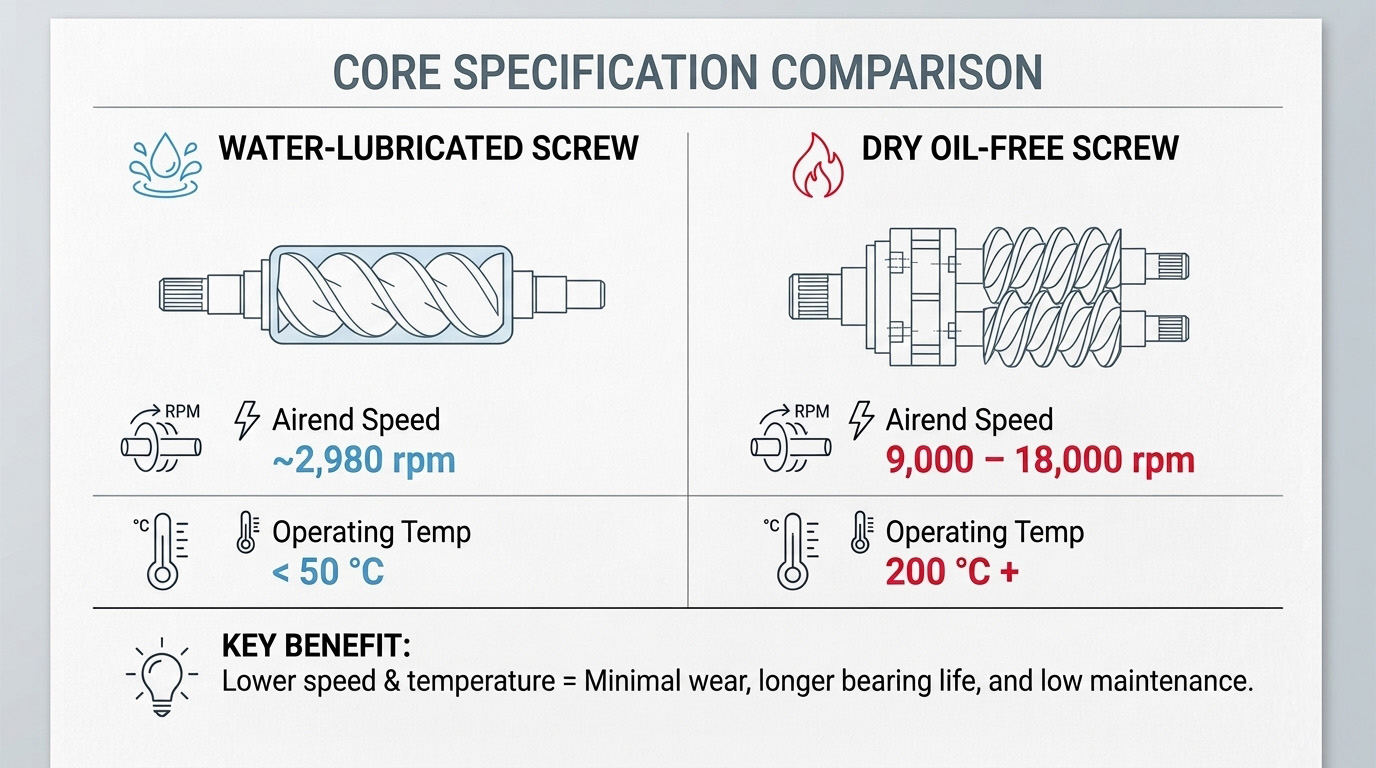
| Airend Speed | ~2,980 rpm | Far lower than dry screw (9,000–18,000 rpm), meaning less wear |
| Operating Temp | <50°C | vs. 200°C+ for dry screw; lower thermal stress on components |
That last spec is the one that matters most. A dry screw airend running at 18,000 rpm and 200°C is a precision instrument operating at its limits. A water-lubricated airend running at 2,980 rpm and below 50°C is operating well within them. In practice, that translates to longer bearing life, fewer seal failures, and lower long-term maintenance costs.
Most buyers focus on purchase price. The real conversation should be about 10-year total cost of ownership. Here's how the two oil-free technologies compare:
| Cost Factor | Dry Screw Oil-Free | Water-Lubricated Oil-Free |
|---|---|---|
| Purchase Price (comparable output) | Baseline +30–50% vs. oil-lubricated | Baseline +15–25% vs. oil-lubricated |
| Energy Consumption | Higher (200°C+ operation, multi-stage) | Lower (isothermal operation, single-stage) |
| Annual Maintenance | Bearings, seals, coatings — expensive | Air filter + water filter — modest |
| Airend Service Interval | 2–4 years (overhaul) | 8,000+ hours before star wheel consideration |
| Oil Contamination Risk | Zero | Zero |
| Water Treatment Requirement | None | RO or purified water supply needed |
The maintenance difference is significant. Water-lubricated units require air filter replacement every 500–2,000 hours (depending on environment) and water filter replacement every 2,000–4,000 hours. That's it for routine service — no oil, no oil filters, no oil separators, no oil disposal. The star wheel plate inside the airend may need attention after 8,000+ hours or two years of operation, but that's a planned service, not a breakdown.
Dry screw machines, by contrast, have higher-speed bearings and precision coatings that wear over time. A typical dry screw airend overhaul at year 3–5 can run €15,000–€25,000 depending on size. That's a cost most first-time buyers don't factor in.
Strong fit:
Where you should think twice:
1. What water quality does the machine require, and what's the cost of maintaining it?
This is the single biggest hidden cost in water-lubricated compressor ownership. Some manufacturers specify RO water; others accept softened water. Ask for the specific water quality specification — conductivity, hardness, particulate limits — and the cost of the filtration system needed to meet it. If the supplier can't give you a clear answer, that's a red flag.
2. Is the Class 0 certificate for the complete package or just the airend?
Same trap as dry screw. Demand a certificate covering the complete compressor package including aftercooler, piping, and dryer. The Dream DMWV-G series lists ISO 8573-1 Class 0 certification for the package, which is what your auditor will want to see.
3. What's the real turndown ratio with VSD?
Water-lubricated airends handle low-speed operation better than dry screw units because the water film maintains sealing even at reduced speeds. But there's still a minimum stable speed. Ask for the specific percentage of rated flow at which the machine can operate continuously without surging. With VSD, most water-lubricated units hold stable down to 25–30% of rated capacity.
4. Who services it in my region, and what's their experience with water-lubricated technology?
This is critical. Water-lubricated screw compressors are less common than dry screw in some markets, which means fewer trained technicians. Get the name and location of the actual service provider, and ask how many water-lubricated units they currently maintain. A distributor who's never opened one of these machines is not a service partner.
5. What's the water consumption and disposal profile?
Water-lubricated machines consume some water through evaporation and blowdown. Ask for the specific consumption rate at your operating pressure and flow. Also confirm that the condensate discharge meets your local environmental regulations — in most cases it's clean enough for normal drainage, but check.
Dry screw oil-free compressors are the right choice for high-pressure applications and environments where water supply is unreliable. They're mature, proven, and widely serviced.
Water-lubricated oil-free compressors are the right choice for everything else — especially food, pharma, and electronics plants where Class 0 air is non-negotiable but where maintenance simplicity and long-term cost matter as much as the certificate on the wall. They run cooler, last longer between overhauls, and cost less to own over a 10-year horizon.
The question isn't which technology is "better." It's which one fits your plant's actual operating reality. Know your water situation, know your maintenance capability, and know your pressure requirement. Those three answers will tell you which way to go.