In many industrial facilities, compressed air is often referred to as the "fourth utility" after electricity, water, and gas. Yet, despite its critical role in production, compressed air quality is frequently overlooked until contamination becomes a costly problem.
For industries such as food processing, pharmaceuticals, electronics, semiconductors, and lithium battery manufacturing, compressed air does more than power equipment. It comes into direct or indirect contact with products, packaging, and sensitive manufacturing processes. Even trace amounts of oil contamination can lead to product defects, regulatory issues, production downtime, and significant financial losses.
As a result, an increasing number of manufacturers worldwide are moving away from traditional oil-injected compressors and investing in dry oil-free screw air compressors that deliver ISO 8573-1 Class 0 certified compressed air.
But what exactly makes dry oil-free technology different? Why do leading global manufacturers prefer oil-free systems despite their higher initial investment? And how can buyers determine whether a dry oil-free compressor is the right choice for their facility?
This guide answers those questions while providing practical insights for engineers, maintenance managers, and procurement professionals.
When evaluating an air compressor, many buyers focus primarily on purchase price and energy consumption. However, in industries where air quality directly affects production, contamination costs often exceed equipment costs.
Consider the following examples:
Food and Beverage Processing
Compressed air is commonly used for bottle blowing, packaging, filling, and product conveying. If oil-contaminated air enters the process, entire production batches may need to be discarded.
Pharmaceutical Manufacturing
Good Manufacturing Practice (GMP) regulations require strict control of production environments. Oil contamination can jeopardize compliance and lead to costly audits or recalls.
Electronics and Semiconductor Production
Modern semiconductor manufacturing involves extremely sensitive processes. Even microscopic oil particles can affect product yield and reliability.
Lithium Battery Manufacturing
Battery production requires clean, stable compressed air throughout multiple production stages. Oil contamination may compromise battery performance and safety.
For these reasons, many multinational companies now specify ISO 8573-1 Class 0 compressed air as part of their procurement standards.
One common misconception is that an oil-free compressor contains no lubricating oil whatsoever.
In reality, bearings and transmission components still require lubrication. The difference lies in the compression chamber itself.
Oil-Injected Screw Compressors
Traditional oil-injected screw compressors introduce lubricating oil directly into the compression chamber to:
While modern filtration systems significantly reduce oil carryover, the compressed air still comes into contact with oil during the compression process.
Dry Oil-Free Screw Compressors
A dry oil-free compressor uses a completely different approach.
No lubricating oil enters the compression chamber.
Instead, the system relies on:
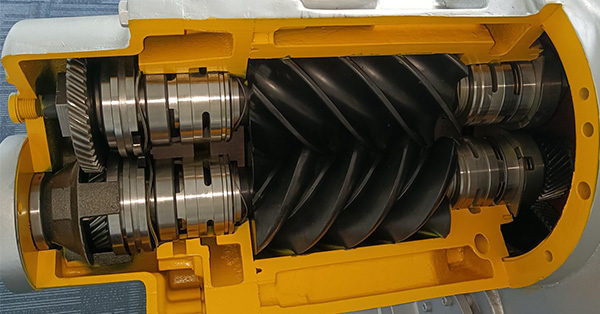
Because air never comes into contact with oil during compression, the risk of oil contamination is virtually eliminated.
This design enables dry oil-free compressors to achieve the highest air purity levels required by critical industries.
One of the most important differences between standard compressors and premium dry oil-free systems is the use of two-stage compression.
This is not simply a design preference—it is a necessity.
In oil-injected compressors, the injected lubricant absorbs a significant amount of compression heat. Without oil in the compression chamber, dry oil-free compressors must manage heat through alternative methods.
If compression is performed in a single stage:
To overcome these challenges, most industrial dry oil-free compressors use a two-stage compression design:
First Stage Compression → Inter-cooling → Second Stage Compression
This configuration provides several important advantages.
Lower Operating Temperatures
Intercooling removes heat between compression stages, reducing overall discharge temperature.
Improved Compression Efficiency
Each compression stage operates at a lower compression ratio, minimizing internal losses.
Reduced Energy Consumption
Two-stage compression generally requires less power than single-stage compression at the same pressure.
Longer Equipment Life
Lower temperatures and reduced mechanical stress contribute to greater reliability and extended service life.
For facilities operating continuously, these benefits can significantly reduce total lifecycle costs.
When researching oil-free compressors, buyers frequently encounter the term "Class 0."
ISO 8573-1 is the internationally recognized standard for compressed air quality.
Class 0 represents the highest level of air purity available under this standard.
In practical terms, Class 0 certification demonstrates that compressed air contains significantly lower oil contamination levels than the limits defined for Class 1 air.
Industries that commonly require Class 0 air include:
When evaluating suppliers, buyers should verify independent Class 0 certification rather than relying solely on marketing claims.
Many buyers struggle with the question:
"Is an oil-free compressor really worth the extra investment?"
The answer depends on the cost of contamination within your production process.
| Comparison Item | Dry Oil-Free Compressor | Oil-Injected Compressor |
|---|---|---|
| Air Quality | ISO Class 0 | Risk of oil carryover |
| Food Industry | Highly Recommended | Requires extensive filtration |
| Pharmaceutical Industry | Highly Recommended | Higher contamination risk |
| Electronics Manufacturing | Highly Recommended | Potential quality concerns |
| Compression | Two Stage | Single or Two Stage |
| Maintenance Cost | Less (no cost for the lubricating oil, oil filter, or oil-air separator; the main consumable is the air filter.) | Higher |
| Repair of core components | high-risk and costly. Repairing precision components such as rotors and bearings is technically challenging and extremely expensive; overhauling or replacing the main unit represents a significant expense. | Maintenance is relatively straightforward. Conventional mechanical repair techniques are well-established, and the cost of replacing parts is relatively manageable. |
| Initial Investment | Higher | Lower |
| Overall designed service life | around 70,000 hours | around 100,000 hours |
| Contamination Risk | Extremely Low | Present |
While oil-injected compressors typically have a lower initial cost, contamination-related expenses can quickly surpass the initial savings in critical manufacturing environments.
As shown in the comparison table above, special attention must be paid to intake air quality during daily operation of dry oil-free compressors.
The air filter is the core component. These compressors have extremely high requirements for intake air quality. The filter element must be cleaned or replaced strictly according to the scheduled intervals to prevent contaminants from entering and damaging the rotors.
Once the rotor coating wears out — due to ingesting fine particles or prolonged operation at high temperatures — efficiency drops significantly. This may ultimately lead to costly repairs or even complete replacement.It is very important to strictly follow the maintenance manual’s schedule when replacing the air filter.
Both dry oil-free and water-lubricated compressors can provide oil-free compressed air.
However, they serve different operational requirements.
| Comparison Item | Dry Oil-Free | Water-Lubricated |
|---|---|---|
| Compression Method | Dry Compression | Water-Lubricated Compression |
| Air Quality | Class 0 | Class 0 |
| Pressure Capability | Wider Range | Typically Lower |
| Large Flow Applications | Excellent | Moderate |
| Water Quality Requirements | None | High |
| Heavy Industrial Use | Ideal | Limited in some applications |
Dry oil-free compressors are often preferred for large industrial plants requiring high flow rates, higher pressures, and continuous operation.
Water-lubricated compressors can be an excellent solution for certain medium-duty applications where lower operating noise and simplified compression chambers are priorities.
While almost any facility can benefit from clean compressed air, certain industries have particularly strict requirements.
Supporting clean-room manufacturing environments.
Reducing product defects caused by airborne contaminants.
After working with industrial buyers worldwide, several purchasing mistakes appear repeatedly.
The compressor's purchase price represents only a small portion of its total lifecycle cost.
Always verify independent ISO 8573-1 Class 0 certification.
A system sized only for today's demand may become inadequate after production expansion.
Pay attention to:
Oil-free systems require specialized expertise.
Reliable after-sales support is often as important as the equipment itself.
As a professional industrial air compressor manufacturer in China, DREAM Compressor specializes in delivering reliable compressed air solutions for global industries.
Our dry oil-free screw air compressors are designed for applications where air purity, reliability, and energy efficiency are critical.
Key features include:
DREAM oil-free compressors are widely used in food processing, pharmaceuticals, electronics manufacturing, medical industries, and lithium battery production facilities around the world.
Whether you require a standalone compressor or a complete compressed air station solution, our engineering team can help design a system that matches your operational requirements.
Compressed air quality is no longer just a technical consideration—it is a business decision that directly impacts product quality, operational reliability, and long-term profitability.
For manufacturers operating in industries where contamination is unacceptable, dry oil-free screw air compressors provide a proven solution for achieving clean, reliable, and efficient compressed air.
While the initial investment may be higher than traditional oil-injected systems, the long-term benefits of reduced contamination risk, improved product quality, and regulatory compliance often make oil-free technology the smarter investment.
Looking for Reliable Oil-Free Air Solutions?
DREAM Compressor provides high-performance dry oil-free screw air compressors and complete compressed air system solutions for industrial applications worldwide.
WhatsApp: +86 136 7155 1445
Email: [email protected]
Contact our team today for expert advice and factory-direct pricing.