Pakistan is one of the world‘s largest textile-producing countries. Textile exports contribute a significant share of the national economy, and thousands of spinning, weaving, dyeing, and finishing facilities operate around the clock.
In this environment, energy costs are a constant pressure. Over the past few years, electricity prices in Pakistan have risen sharply. For many textile mill owners, the question is no longer “which compressor should I buy?” but “how do I keep my electricity bill under control without shutting down production?”
That’s where compressed air comes in—and where many mills are leaving money on the table.
Walk into any textile mill in Faisalabad, Lahore, or Karachi, and you’ll find compressed air running through almost every stage of production.
In the blowroom, it moves fiber through ducts and removes dust. In spinning, it powers suction systems for yarn handling and cleaning. In weaving—especially air-jet looms—compressed air is the actual mechanism that inserts the weft yarn across the loom. Even a small pressure drop can cause fabric defects or machine stoppages.-1
Beyond that, compressed air drives dyeing equipment, pneumatic conveying systems, and packaging lines.-1
The point is this: compressed air isn’t a supporting utility in a textile mill. It’s part of the production process itself.
And that means when your air compressor isn’t efficient, you’re not just wasting electricity—you’re making your entire operation more expensive to run.
Here’s something many people don’t realize.
Most textile processes only require 2 to 5 bar of pressure. Spinning machines, air-jet looms, dyeing vats—they don't need 8 bar or 10 bar. They need volume, not high pressure.
But many mills still use standard 8-bar or 10-bar compressors, then throttle the pressure down with regulators. That’s like buying a truck to carry a suitcase. The compressor works harder than it needs to, generates more heat, consumes more power, and wears out faster.
In some factories, compressed air systems account for 10% to 30% of total electricity consumption-2. When you’re running 24/7, that adds up fast.
A two-stage screw air compressor does something different.
Instead of compressing air from atmospheric pressure all the way to the final pressure in one step, it splits the work into two stages with cooling in between.-3
First stage: air is partially compressed.
Then it passes through an intercooler, which removes some of the heat.
Second stage: air is compressed to the final pressure.
Why does this matter? Because compression creates heat—and heat is wasted energy. By cooling the air between stages, a two-stage compressor reduces the total energy required to reach the same final pressure.
In practical terms, switching from a single-stage to a two-stage compressor can reduce energy consumption by roughly 10% to 15% under typical textile production loads.-3
That might not sound huge. But for a 100 kW compressor running 6,000 hours a year, 10% savings means roughly 60,000 kWh less per year. At Pakistan’s industrial electricity rates, that’s real money—year after year.
Here’s where it gets even more relevant for textile mills.
DREAM offers low-pressure two-stage compressors designed specifically for applications that need 2–5 bar—not 8 bar.-1 These machines deliver large air volumes at lower pressure, without the energy waste that comes from over-compressing and throttling down.
For spinning mills, weaving sheds, and dyeing plants running multiple production lines, this can make a meaningful difference in monthly electricity bills.
We recently worked with a textile mill in Pakistan that was running several conventional single-stage compressors. Their electricity costs had been climbing, and they were looking for a way to bring them down without compromising production.
After evaluating their system, we recommended upgrading to a two-stage oil-injected screw compressor.
The results were straightforward:
Nothing dramatic—just steady, measurable improvement. That’s what most textile mills are actually looking for.
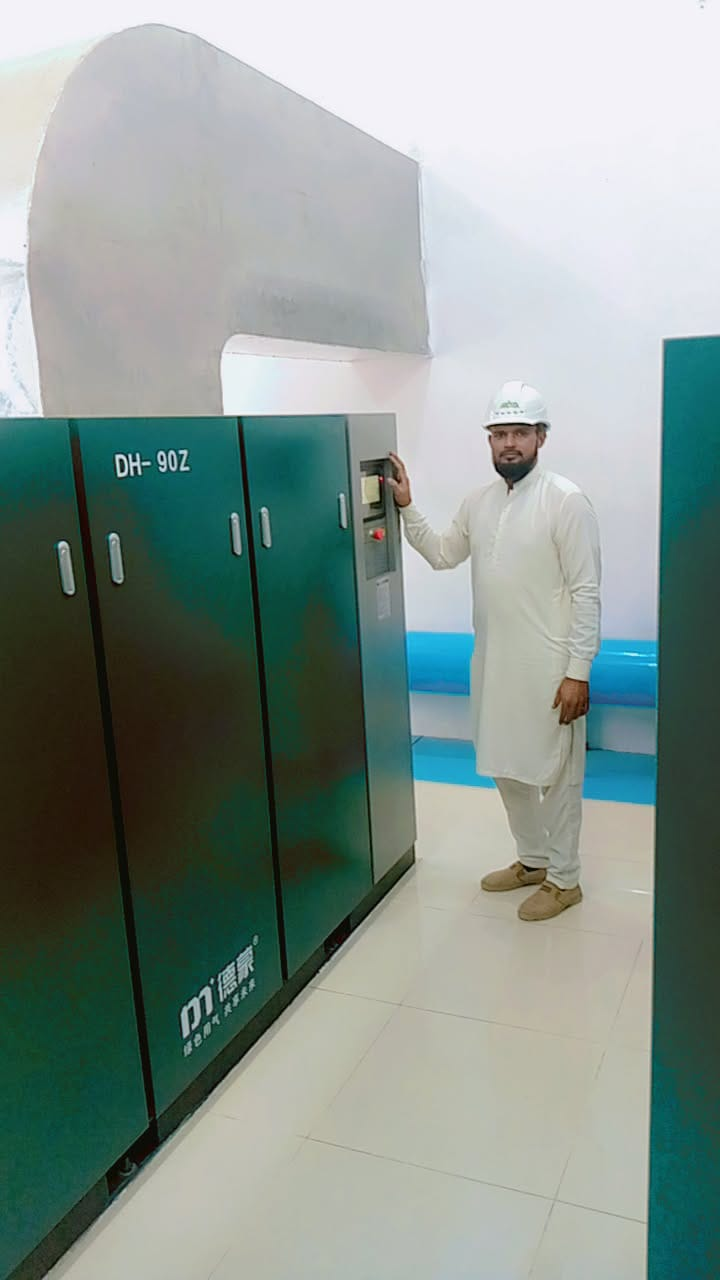
DREAM Compressor is a professional industrial air compressor manufacturer based in China, with over a decade of experience in the industry. Our equipment is CE and ISO certified and exported to more than 30 countries.
For textile applications, we offer:
We don’t claim to be the cheapest option. But we do build equipment that stays reliable year after year—and that’s what keeps operating costs down over the long run.
For textile mills in Pakistan, the pressure is real—not just from the compressors, but from rising energy costs and tight margins. Choosing the right air compressor isn’t a minor procurement decision. It directly affects how much it costs to run the mill every single month.
Two-stage screw compressors offer a practical way to reduce that cost. They use less energy, run cooler, and deliver more stable pressure than single-stage alternatives. For mills running 24/7, the savings add up quickly.
DREAM Compressor specializes in:
WhatsApp: +86 136 7155 1445
Email: [email protected]
Contact us for a free energy-saving assessment for your textile mill.