PET bottle blowing is one of the most air-intensive processes in the packaging industry. From preform stretching to high-pressure blowing, the quality, stability, and efficiency of compressed air directly affect bottle quality, production speed, and operating costs. Choosing the right air compressor for PET bottle blowing applications is therefore a critical decision for manufacturers aiming to balance performance, energy consumption, and total cost.
This guide explains the key selection criteria, compares compressor technologies, and outlines optimized compressed air solutions for modern PET blowing lines.
PET bottle blowing relies on compressed air at different pressure levels:
Any fluctuation in compressed air quality or pressure can lead to defects such as uneven wall thickness, deformation, or increased scrap rates.
PET bottle blowing typically requires high pressure compressor systems ranging from 20 to 40 bar, combined with stable airflow. Insufficient pressure or unstable flow can interrupt the blowing cycle and reduce productivity.
Modern rotary screw air compressors are widely used due to their continuous air delivery and ability to handle variable demand more efficiently than traditional systems.
Compressed air quality is a major consideration in PET bottle manufacturing.
For auxiliary air and air recovery systems, low-pressure oil-free rotary screw compressors provide clean, reliable air while minimizing contamination risks.
Traditionally, reciprocating compressors were commonly used for PET bottle blowing due to their ability to reach high pressures. However, they often involve:
In contrast, oil-injected rotary screw air compressors designed for medium and high pressure offer:
This makes rotary screw solutions increasingly preferred for modern PET blowing plants.
Energy consumption accounts for a significant portion of the total cost of ownership of air compressors in PET bottle blowing applications.
Key strategies to reduce energy consumption include:
An optimized compressed air system can reduce energy costs by 20–35% over its lifecycle.
For the core blowing process, 20–40 bar oil-injected rotary screw air compressors provide reliable high-pressure compressed air with excellent efficiency.
DREAM DR-Z & DRV-Z Series are designed for PET bottle blowing lines requiring stable pressure and continuous operation:
These compressors help manufacturers achieve consistent bottle quality while controlling operating costs.
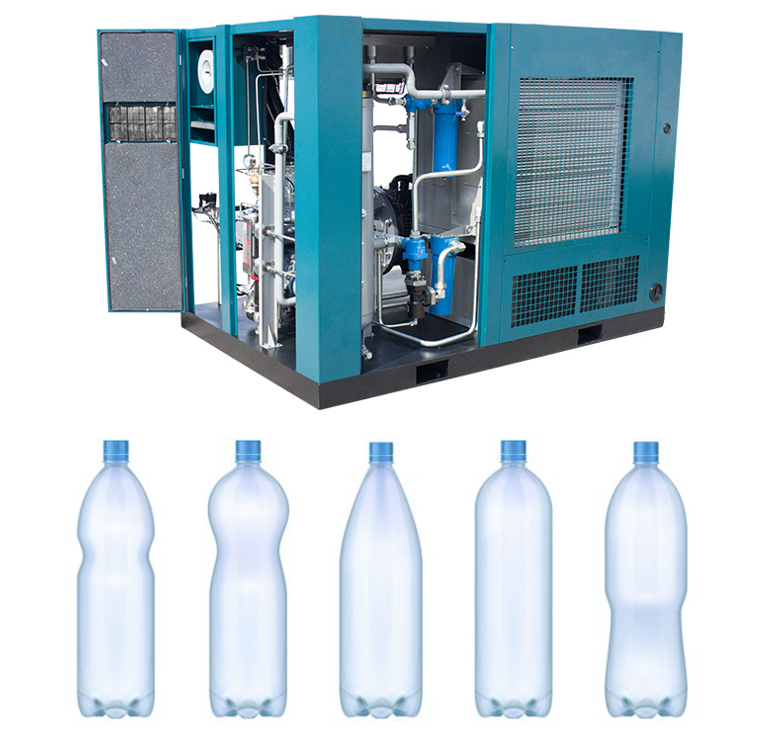
PET bottle blowing lines also require large volumes of clean, low-pressure air for:
The DREAM DMWLV-G Series Low-Pressure Dry Oil-Free Rotary Screw VSD Compressor delivers Class 0 oil free air at 2–3 bar, making it ideal for these applications:
Combining oil-free air systems with high pressure compressors creates a balanced and cost-effective compressed air solution.
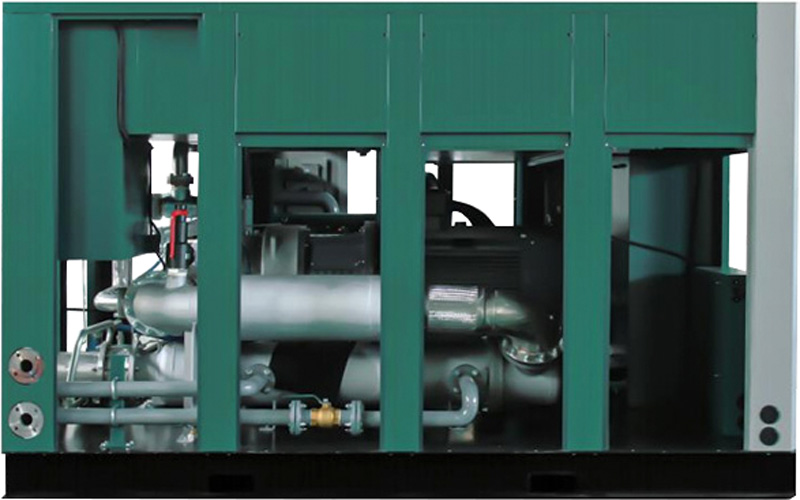
Instead of relying on one oversized high pressure compressor, leading PET manufacturers adopt a multi-pressure compressed air system, separating:
This approach significantly reduces energy consumption, improves system reliability, and lowers the total cost over time.
Most PET bottle blowing applications require compressed air between 20 and 40 bar, depending on bottle size, mold design, and production speed.
Oil free air is strongly recommended, especially for food and beverage packaging. Class 0 oil-free compressors eliminate the risk of oil contamination and help meet hygiene standards.
Yes, but many manufacturers are replacing reciprocating compressors with rotary screw air compressors due to better energy efficiency, lower maintenance, and quieter operation.
Energy consumption can be reduced by:
The biggest factor affecting total cost is energy consumption, followed by maintenance and downtime. Choosing the right compressor technology and system configuration is key to long-term savings.
Choosing the right air compressor for PET bottle blowing applications requires a clear understanding of pressure requirements, air quality standards, and energy efficiency goals. By combining high pressure rotary screw air compressors with low-pressure oil free air systems, manufacturers can achieve stable production, reduced energy consumption, and lower total cost—while meeting the strict quality demands of modern PET bottle manufacturing.