A centrifugal compressor is a type of air compressor and gas compressor designed to convert kinetic energy into pressure energy through continuous, high-speed gas movement. Unlike positive displacement machines such as the reciprocating compressor, centrifugal compressors rely on rotating components to accelerate gas flow and increase pressure in a smooth, steady process.
These compressors are widely used in industrial environments that require a wide range of flow capacities, stable pressure gas delivery, and high efficiency under continuous operation. Their ability to handle high speeds, large volumes of compressed air, and oil free operation makes them a preferred choice for process industries, energy systems, and gas handling applications.
A centrifugal compressor is a dynamic compressor that raises gas pressure by accelerating gas through a rapidly rotating impeller and converting the resulting high velocity into pressure.
Instead of trapping gas in chambers, centrifugal compressors move gas continuously. The compression occurs as gas exiting the impeller enters a stationary diffuser or volute or scroll, where velocity is reduced and pressure increases.
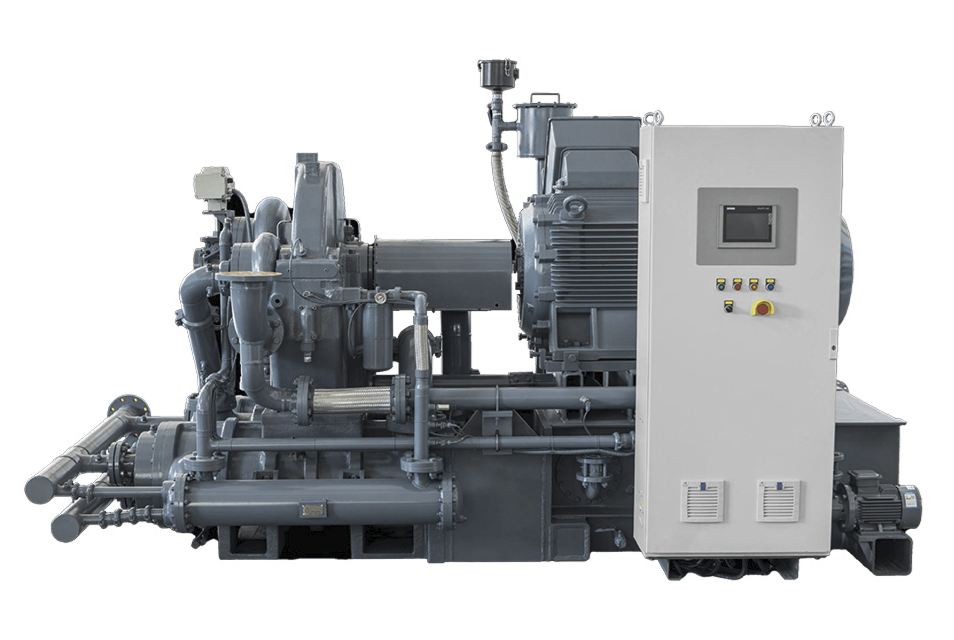
The impeller is the rotating component responsible for accelerating gas flow. It determines flow rate, efficiency, and pressure capability.
These stationary parts convert kinetic energy into pressure energy by slowing down the gas and directing it toward the discharge outlet.
Inlet guide vanes control capacity and efficiency by adjusting the angle at which gas enters the impeller, allowing precise regulation without excessive energy loss.
These components support the impeller and ensure stable operation at high rotational speeds.
| Feature | Centrifugal Compressor | Reciprocating Compressor |
|---|---|---|
| Gas flow | Continuous | Pulsating |
| Capacity | High volumes | Low to medium |
| Efficiency at scale | High efficiency | Decreases at large flow |
| Maintenance | Lower | Higher |
| Oil free capability | Common | Limited |
| Typical use | Process industries, air systems | Small gas compression |
Centrifugal compressors are used across many sectors where stable compressed air and gas handling are required.
In gas turbines, centrifugal compressors supply compressed air for combustion and cooling, ensuring stable airflow under varying load conditions.
Used for gas boosting, vapor recovery, and pipeline compression where continuous flow and oil free operation are preferred.
Provide controlled gas flow for chemical reactions, separation processes, and product handling.
Centrifugal air compressors support large-scale compressed air systems in steel, cement, and manufacturing facilities.
Used in large chillers and cooling plants requiring high efficiency and smooth gas compression.
Centrifugal compressors maintain high efficiency when handling large volumes of gas and compressed air, making them suitable for continuous-duty operations.
Many centrifugal designs operate without oil in the compression chamber, making them suitable for applications requiring clean gas flow.
Unlike piston machines, centrifugal compressors deliver non-pulsating flow, improving downstream process stability.
With multi stage configurations, centrifugal compressors can achieve higher pressure energy while maintaining efficiency.
Used where moderate pressure increase is sufficient, such as in ventilation systems or low-pressure air supply.
Applied when higher pressure gas is required, such as in chemical processing or air separation plants.
Allow each impeller to operate at its optimal speed for maximum performance and energy savings.
A centrifugal compressor is used to compress air or gas in applications requiring large flow rates, stable pressure, and high efficiency, such as power generation, oil and gas processing, chemical plants, and industrial air systems.
It increases pressure by converting kinetic energy from a high-speed impeller into pressure energy as gas slows down in the diffuser and volute.
Many centrifugal compressors are designed for oil free compression, making them suitable for clean air and gas applications.
Centrifugal compressors use dynamic energy and continuous flow, while reciprocating compressors use piston-driven displacement with pulsating flow.
A centrifugal compressor is suitable when large volumes, continuous operation, high efficiency, and low maintenance are required.
Centrifugal compressors convert kinetic energy into pressure energy through high-speed gas movement, offering a reliable solution for industrial compressed air and gas systems. Their ability to operate efficiently at large capacities, handle high velocity gas flow, and support oil free compression makes them suitable for a wide range of industrial applications.
From gas turbines and petrochemical plants to air separation units and manufacturing facilities, centrifugal compressors continue to support modern industrial processes where stable gas flow, high efficiency, and long-term operational performance are required.