In the textile industry, reliable and efficient compressed air is essential for spinning, weaving, dyeing, and finishing processes. Oil-injected rotary screw compressors are widely used for these applications due to their ability to deliver stable low-pressure air with consistent flow.
While single-stage rotary screw air compressors are common for smaller requirements, two-stage oil-injected compressors are increasingly preferred because they achieve higher efficiency through staged compression and reduced energy loss. These systems help lower operating costs while maintaining high-quality compressed air for sensitive textile machinery.
Two-stage oil-injected rotary screw compressors operate by passing air through two compression chambers in sequence. Each stage increases the air pressure incrementally. Oil-injected air lubricates the rotors, reduces friction, and cools the compression chamber, improving efficiency and protecting components.
This staged approach reduces mechanical stress, lowers energy consumption, and improves the cost of ownership compared to a single-stage design.
After compression, the oil injected into the air is removed using an oil separation system. High-efficiency separators and oil filters ensure minimal oil content in the delivered air, making the compressed air suitable for sensitive textile applications.
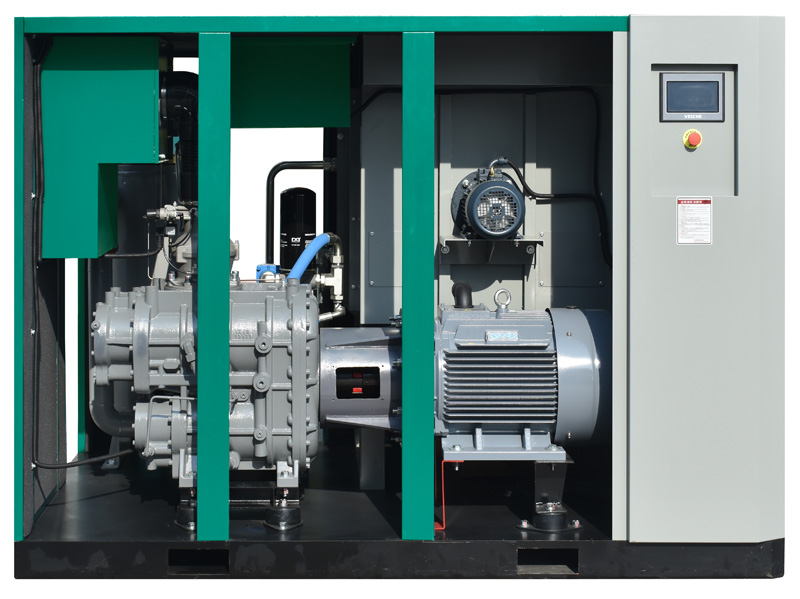
Two-stage rotary screw air compressors operate at higher efficiency under varying load conditions. By reducing compression work per stage and minimizing heat generation, these systems lower operating costs and reduce electricity consumption.
These compressors provide a wide range of air volumes and pressures, allowing textile plants to match compressed air output with demand across different production lines. This flexibility supports both high-speed weaving machines and low-pressure finishing processes.
Although initial investment for two-stage compressors may be higher than single-stage or oil-free models, the savings in energy-efficient operation, reduced maintenance, and extended lifespan of components result in a lower total cost of ownership over time.
By maintaining stable air pressure and using oil-lubricated rotors with effective separation, two-stage compressors provide clean, reliable compressed air. This ensures smooth operation of air-driven textile equipment and reduces downtime.
Two-stage oil-injected rotary screw compressors are suitable for:
These applications benefit from energy-efficient operation and reliable performance of rotary screw compressors.
Energy savings can be estimated by comparing single-stage vs two-stage screw compressors:
Example: For a 100 kW single-stage compressor, switching to a two-stage design can reduce energy consumption by 10–15% under typical textile production loads.
Regular monitoring of oil filters and the oil separation system is essential. Maintaining clean separation systems ensures minimal oil in compressed air and prevents additional wear in downstream equipment, further reducing operating costs.
A two-stage oil-injected screw compressor passes air through two sequential compression chambers, using oil-injected air for lubrication and cooling, producing stable low-pressure air efficiently.
They offer higher energy efficiency, more stable pressure, and a wide range of air volumes compared to single-stage compressors, reducing operating costs.
Yes. Modern compressors include high-efficiency oil separation systems and oil filters to minimize oil content, ensuring clean, reliable compressed air.
By splitting compression into two stages, each stage does less work per unit of air, reducing the total energy required for the same output pressure.
Two-stage oil-injected rotary screw compressors provide a reliable, energy-efficient, and flexible compressed air solution for the textile industry. By combining staged compression, oil-lubricated rotors, and efficient oil separation systems, these compressors reduce operating costs while delivering stable air for a wide range of textile applications.
For textile plants aiming to improve energy efficiency and maintain high-quality compressed air, low-pressure two-stage oil-injected screw compressors offer a proven solution that balances performance, cost, and reliability.