Often referred to as the fourth utility, compressed air has become one of the driving forces of modern-day industry and daily operations. Alongside electricity, water, and gas, compressed air supports manufacturing, construction, automotive services, pharmaceuticals, food and beverage production, agriculture, and countless industrial processes.
Air compressors serve as the backbone of compressed air systems, converting mechanical energy into pressurized air that can power pneumatic tools, automation equipment, and industrial machinery. Businesses across the globe depend on compressed air for productivity, safety, and efficiency.
But the technology behind air compressors did not emerge overnight. It developed through thousands of years of experimentation, engineering progress, and industrial transformation.
The earliest concept of air compression can be traced to the human lung, which primitive people used to blow on embers to create and sustain fire. Human lungs can generate only 0.02 to 0.08 bar of air pressure, which was sufficient for basic combustion but inadequate for metallurgical processes.
As civilizations began smelting metals such as gold, copper, and tin, stronger airflows and higher temperatures became necessary. This demand led to the first mechanical attempts at air compression.
Early metallurgists in Egypt and Mesopotamia used blowpipes and operated bellows to intensify furnace temperatures. By 1500 BC, foot-operated bellows were developed, allowing continuous airflow and freeing the operator’s hands.
These devices consisted of flexible chambers that expanded and contracted to force air into furnaces. The bellows represent the first mechanical system designed to generate compressed air on demand.
In 1762, engineer John Smeaton designed a water wheel-driven blowing cylinder, replacing manual bellows with mechanized airflow. This marked a shift from human-powered air delivery to automated systems.
Smeaton’s work laid the groundwork for scientific engineering approaches to airflow, air pressure, and mechanical efficiency.
In 1776, English inventor John Wilkinson introduced an advanced blasting machine capable of generating higher air pressure. This system became an early prototype for mechanical compressors and was used in metallurgy and mining operations.
By 1829, the first compound air compressor, which compressed air through successive cylinders, was patented. This technology improved pressure output and efficiency, setting the stage for industrial-scale compressed air systems.
One notable early application was the construction of the Mount Cenis Tunnel in the Swiss Alps. Initially, workers drilled only nine inches per day by hand. After compressed air drills were introduced in 1862, the project accelerated and was completed in about 14 years, significantly faster than expected.
During the Second Industrial Revolution, compressed air became a practical industrial power source. Factories adopted stationary machines driven by steam and compressed air, enabling mass production of goods.
Compressed air supported:
This period transformed compressed air from a metallurgical tool into a universal industrial energy medium.
By the early 1900s, portable air compressors mounted on wheels were introduced. These systems often used single-stage compression cylinders driven by steam or oil engines.
The invention of lightweight pneumatic tools such as drills and nail guns enabled rapid construction of skyscrapers, roads, and suburban communities. Compressed air became essential for powering tools in construction and manufacturing.
In 1933, the first two-stage air-cooled portable compressor was manufactured. Standardized ratings for free air delivery were later established, improving consistency and performance measurement across the industry.
A major breakthrough occurred when Swedish engineer Alf Lysholm designed the first twin rotary screw compressors in the 1930s while working on steam and gas turbine research. The screw compressor was patented in 1935 and later adopted worldwide.
Rotary screw compressors offered continuous airflow, reduced vibration, and improved durability compared to piston compressors, making them suitable for heavy duty industrial applications.
Compressed air systems expanded rapidly across industries such as:
Compressed air powered drills, pumps, stamping machines, and automation equipment, becoming an integral industrial utility.
Today, modern air compressors integrate digital monitoring, variable speed drives, and energy management systems. Smart compressors help industries reduce energy consumption and improve operational efficiency.
Compressed air continues to evolve as industries adopt automation, robotics, and Industry 4.0 technologies.
Compressed air systems typically include:
The compressor pressurizes ambient air and stores it in a tank. When air pressure drops, the compressor restarts automatically, maintaining system stability.
Each configuration is selected based on application requirements, mobility needs, and maintenance preferences.
Air compressors are categorized by discharge pressure:
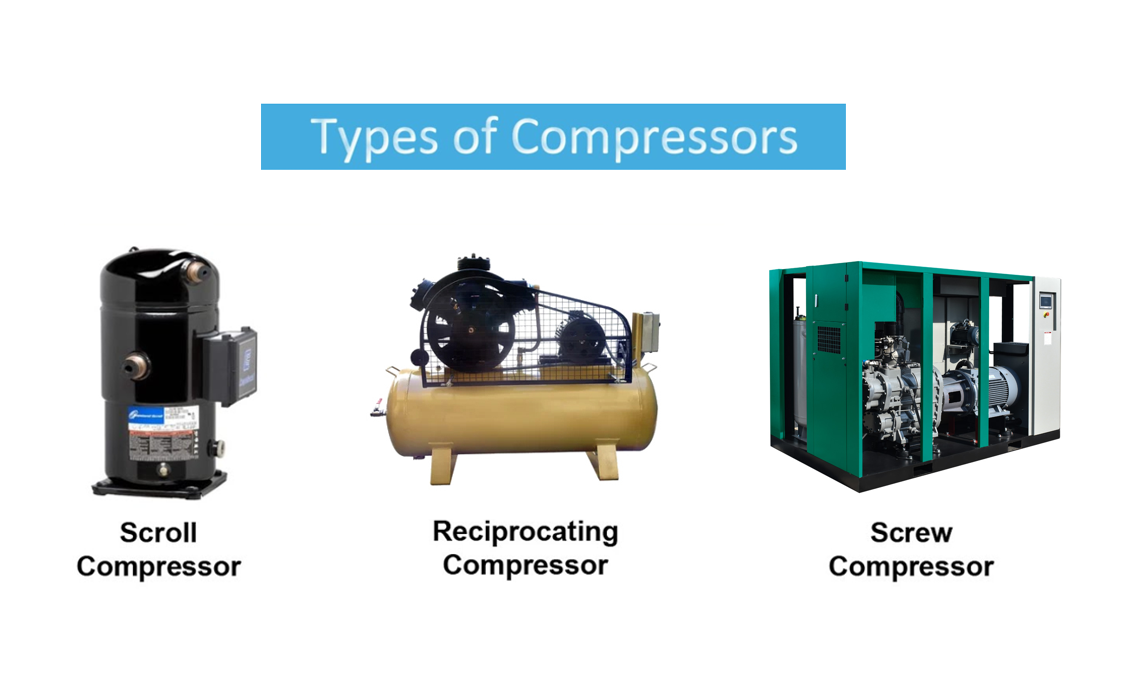
These compressors use oil for lubrication, reducing friction and extending service life. They are widely used in heavy duty industrial applications due to durability and lower maintenance frequency.
Oil-free compressors provide cleaner compressed air and are commonly used in pharmaceuticals, food processing, and electronics. They are lighter and more portable but may require more frequent servicing.
Compressed air is used in:
Early air compression concepts date back to 1500 BC, with mechanical compressors emerging during the industrial revolution.
Alf Lysholm patented the twin screw compressor in Sweden in 1935.
Compressed air provides a flexible and safe energy source for tools and machines across many sectors.
Compressed air is air stored under pressure and used as an energy source for industrial and mechanical applications.
The compressor converts mechanical power into pressurized air stored in a tank.
Compressors handle gases, while pumps move liquids.
They are used for continuous industrial operations requiring stable airflow and high efficiency.
Design, compression stages, and operating parameters determine air pressure levels.
Oil-free compressors provide cleaner air, while oil-lubricated compressors offer durability and lower maintenance frequency.
From primitive bellows and human lungs to digital rotary screw compressors, the history of air compressors reflects human innovation and industrial progress. Compressed air technology continues to adapt to changing industrial needs, supporting productivity and technological development worldwide.